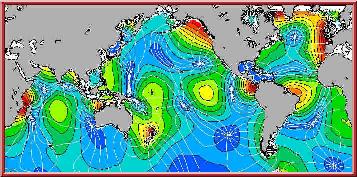
The model provided is a high degree expansion of the effects of Glacial
Isostatic Adjustment on the geoid, using the ICE-3G model as a basis for the ice
loading history. The supplied coefficients represent the time rate of change in
mm/yr of the geoid for the degree/order L/M = 99 computations. There are 7 cases
of lower mantle viscosity and the nominal (Tushingham and Peltier 1991) for the
upper mantle and the "nominal" (Tushingham and Peltier 1991) value for the
lithospheric thickness.
The Lithosphere is modeled as a Maxwell viscoelastic with viscosity = 3.0 *
10**23 Pa-s See Ivins et al. [2001, IAG Vol. 123, GGG2000, M. Sideris (ed.),
Springer Verlag] for other mantle lithosphere and core parameters. The assumed
Lithosphere thickness is 120 km.
This prediction is for the satellite determined gravity harmonics that
correspond to the viscoelastic spherical earth k_l Love number, not the geoid
change relative to the solid surface change (such as in the maps of Mitrovica,
Milne and Davis, GJI, 147, 562-578, equation 8, and in Douglas and Peltier Phys.
Today article) which is quite important to tide-gauge and Quaternary RSL studies
of course.
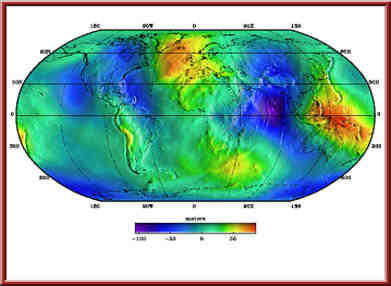
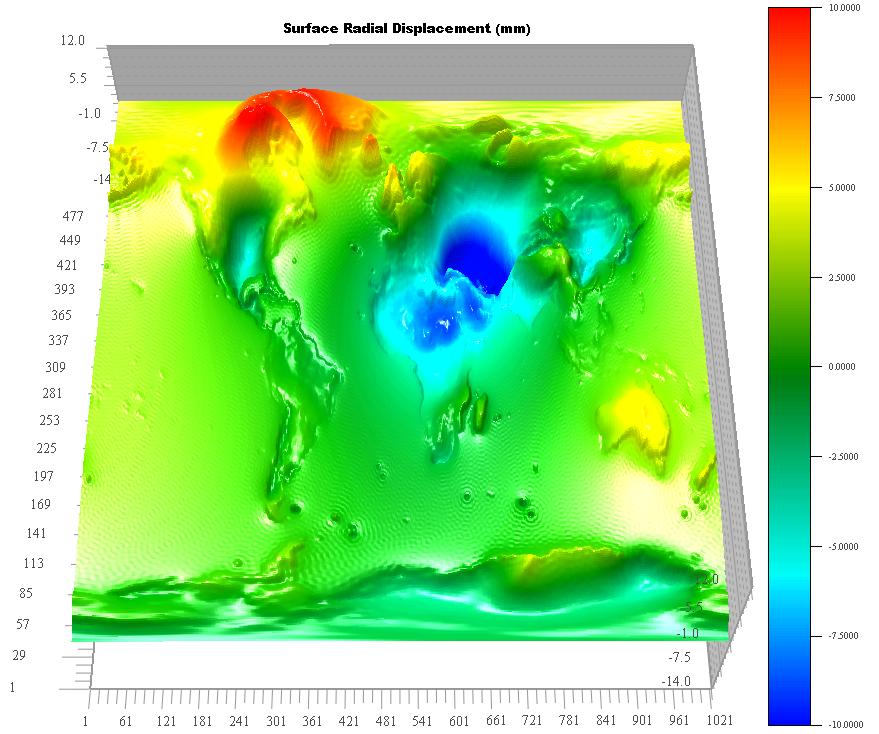
Two example plots are provided, tp99_LM20.120h.ps
(.jpg) and tp99_LM5.120h.ps
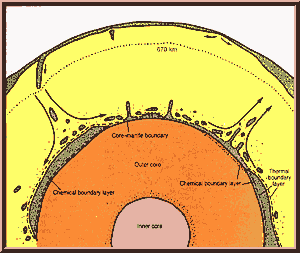
(.jpg), whose labels are self explanatory except for the "delta sub trans z. =
300 km" which is a 300 km zone below the transition (670 km) zone that might
represent a thermal boundary layer of some sort, but here is suppressed in terms
of differing lower mantle viscosity.
One of the interesting features here is the complete insensitivity of the higher
degree and order coefficients to varying lower mantle viscosity (1.0 x 10**21
Pa-s to 70 x 10**21 Pa-s). Also notice in the maps that there are some subtle
long wavelength features that are sensitive to lower mantle viscosity - like the
0.2 mm/yr ("uphill") W-E gradient in geoid change rate across the Sahel (i.e.
Senegal to Tibet).
There is no self-gravitating sea level in the computations so that the time-rate
of change "highs" (at Australia for example) and "lows" (such as west of Ecuador
and the equatorial Atlantic) are directly the result of eustatic + ice loading
and unloading - i.e., without the nonlinear sea level integral equation being
solved. The only comparable calculation is that of Mitrovica and Peltier 1991
(JGR 96, 20,053-20-071 -- Plate 1c), although a nonlinear contour scale
suppressed negative change values at the .1 mm/yr level in the maps in the 1991
work. So the "equatorial oceanic siphoning" predicted here is basically a solid
Earth viscoelastic response phenomenon.
Description of data files:
Data files