NRC Resident Research Associate, NASA/Goddard, Geodynamics Branch
" checking the lava plumbing system..."
Email : sakimoto@denali.gsfc.nasa.gov
Building/Office : 22/C134B
Mailing Address : Code 921, NASA/GSFC, Greenbelt, MD 20771
M.A. Earth and Planetary Sciences, Johns Hopkins University, 1991
Ph.D. Earth and Planetary Sciences (Geophysics), Johns Hopkins University, January, 1995
Modeling geophysical processes in volcanic and planetary thermal evolution problems, including analytic and computational fluid dynamic approaches to magma and lava flow, volcanic resurfacing, and mantle flow.
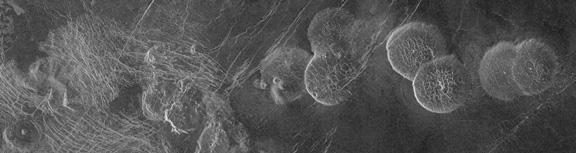
"Venus volcanic domes (D=20 km) and lava plains near Alpha Regio"
Volcanism is a major process in planetary resurfacing and cooling, and a central issue in planetary volcanism is the rates at which lava was erupted and emplaced, and how much heat was associated with the eruption. Large areas of the surfaces of Earth, Venus, and Mars are thought to be covered by basaltic plains volcanism, and there are several basic issues that can be addressed by modeling the emplacement and cooling of these lavas: How far and how fast can the lavas travel in different cooling regimes? Are numerous eruptive centers required for the observed distribution? What was the heat flux from the flows to the atmosphere and how long was it sustained? To what extent are the different volcanic plains styles controlled by the eruptive center locations and sizes, and to what extent are they controlled by different cooling rates of the lavas after eruption? What constraints on the planetary resurfacing and cooling rates can be inferred from the lava eruption rates?
Since lava tube flow is a large component of basaltic plains and shield volcanism, we can assess the flow rates and maximum flow distances for different tube sizes and lava compositions in different planetary cooling environments. We use these--combined with estimations of the minimum number of tube-fed flows necessary to resurface a region from a single or multiple eruptive centers--in order to constrain the resurfacing and heat flux rates for regional and planetary thermal evolution.
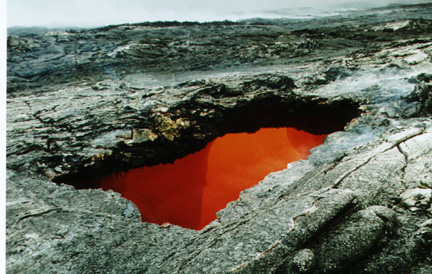
"PuuOo tube system skylight at 2450', 1995 Kilauea eruption."
The known dependence of the cooling lava rheology on both temperature and shear rate has often challenged the accuracy of lava flow modeling. Frequently, either or both of the temperature or the shear rate dependencies is neglected because of either lack of rheological data or simplicity requirements in reaching a solution. However, recent advances in computational solutions have allowed coupled heat and velocity lava flow models, which can handle a variety of complex rheologies. This work is a compilation of existing field, laboratory and theoretical work on the behavior of cooling basaltic lava into a working model of a shear and temperature dependent basalt rheology. ower law flow curves are fit to field and laboratory data for basaltic lava for temperatures ranging from superliquidus to 55% solid. Theoretical constraints are used to determine the general fit parameters where data is unavailable. Both Kilauea-type basalts and the cooler Etna-type basalts are considered. A three-part fit to the data is used to cover the three general regimes of behavior a cooling lava is likely to pass through. For superliquidus to approximately 20% crystals, a standard Newtonian fit with an exponential temperature dependence is used. For 20% to 55% volume crystals, a (shear-rate dependent) power law is fit to the data with a linear temperature dependence for both the power law exponent and the power law coefficient. For 55% volume crystals and higher, the melts is assumed to be crystal-rich enough to behave as an effective solid. We find that the temperature dependence of the model produces flow field results significntly different from isothermal Newtonian models, and that for lavas erupted with high crystallinities the shear rate dependence is as important as the temperature dependence.
This work is part of a study modeling the flow and cooling of volcanic flows on the terrestrial planets in order to better understand both lava flow processes and their role in the thermal evolution of the interiors and atmospheres of the terrestrial planets. For example, we used the CFD program NEKTON (product of Fluent Inc.)to calculate the full three dimensional solution for Bingham flow down a slope and check some of the simplyifing assumptions in a previous analytic analysis that is often used for estimating rheology and flow rate in planetary lava flows. We found that the initial assumptions are problematic--the assumption of a parabolic flow profile along with an assumed criteria for levee depth actually implicitly assumes the relationship between flow width, yield strength, and levee width, rather than deriving it. In the full three-dimensional flow solution (figure 1), the shear stress on the levee walls from the channel prevent stationary levees from forming unless the levee has either a substantially higher viscosity or yield strength than the channel. For example, the CFD solution for Mauna Loa 1942 flow with the parabolic flow cross section and rheology assumed by Hulme (1974) shows that most of the predicted stationary levee area is moving downstream at up to 1/6th of the central channel flow speed (Sakimoto et al., 1996), and that the Hulme method overestimates the 3-D solution's flow rate by a factor of five. Other CFD analyses of lava flows in progress include lava tube flow and lava dome extrusion and emplacement.
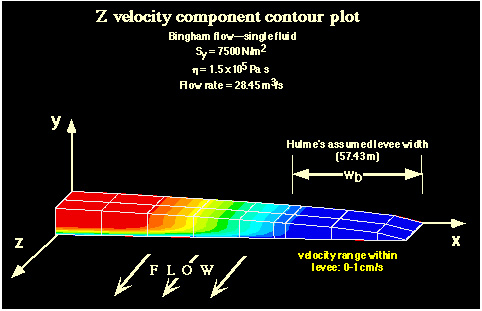
Figure 1. CFD results for the velocity in the downhill direction for a single Bingham fluid with a parabolic cross-section
Previous work includes viscous convective flow models of the effects the subduction of a buoyant ridge would have on the overlying plate topography and volcanism (Sakimoto and Bills, 1994, EOS Trans.).
The Laser Velocity/Range Finder for Active Lava Flows is a new non-coherent laser instrument approach using a fiber optic Fabry Perot filter to measure the doppler shift of the returned signal. The goal is a footprint resolution of 1-3 cm and a velocity resolution of 1 cm/s. The resulting lava velocity profiles will be used to measure determine lava flow properties that cannot be measured directly in the field, and are essential for modeling emplacement and cooling of lava on the terrestrial planets. The PI is Pamela Millar of the Laser Remote Sensing Branch, and the Co-I is Susan Sakimoto. 1996 Summer student help is provided by Gretchen Schroeder from Bucknell University. J. Kauahikaua of the Hawaii Volcano Observatory is providing field testing advice. The Laser Velocity/Range Finder for Active Lava Flows is funded by the NASA/Goddard Director's Discretionary Fund.
"Laser ranger measurements at a lava tube skylight"
Sidekick: Jackie
Recent Publications:
Sakimoto, S.E.H. and M.T. Zuber, Effects of planetary thermal structure on the ascent and cooling of magma on Venus, J. Volcanol. Geotherm. Res., 64, pp 53-60, 1995.
Sakimoto, S.E.H. and M.T. Zuber, The spreading of variable viscosity axisymmetric radial gravity currents: applications to the emplacement of Venusian 'pancake' domes, J. Fluid Mech.,301, pp 65-77, 1995.
Sakimoto, S. S. Baloga, and J. Crisp, 1996, Three-dimensional modeling of leveed lava flows. LPSC XXVII, Houston, TX, 1996.
Gregg, T.K.P., and S. Sakimoto, Venusian lava flow morphologies: Variations on a basaltic theme, LPSC XXVII, Houston, TX, 1996.
Sakimoto, S.E.H., S.M. Baloga, Thermal controls on tube-fed planetary lava flows, LPSC XXVI, Houston, Texas, 1995.
Sakimoto, S.E.H. and M.T. Zuber, Effects of temperature-dependent non-Newtonian rheologies on heat and momentum transport in lava tube flow (abstract), Eos Trans. AGU Fall Mtg. Supp., 1994.
Sakimoto, S.E.H., M.T. Zuber, Terrestrial basaltic counterparts for the Venus steep-sided or 'pancake' domes, LPSC XXV, Houston, Texas, 1994.
Sakimoto, S.E.H. and M.T. Zuber, Temperature-dependent lava tube flow: The influence of flow geometry, non-Newtonian rheology, and thermal boundary conditions, (in preparation for Chapman conference and JGR special section on long lava flows).
Sakimoto, S.E.H., Temperature dependent non-Newtonian models for basaltic lava flow models, (in preparation).
Sakimoto, S.E.H., J. Crisp, and S. Baloga, Eruption constraints on tube-fed planetary lava flows, (in preparation).